
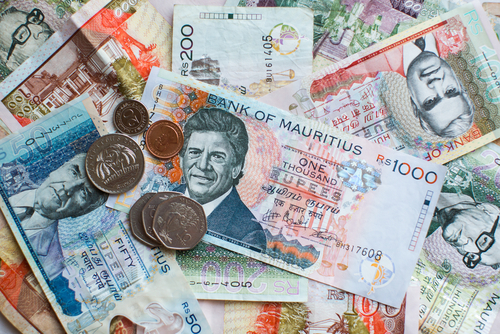
The Mauritian Rupee serves as the sole legal tender across Mauritius, coded as MUR with the symbol ₨. Introduced in 1876 under British colonial administration, it supplanted the Indian rupee that circulated earlier, establishing a distinct monetary identity tied initially to the pound sterling at a fixed rate of one rupee equaling one shilling. The Bank of Mauritius assumed sole issuance rights in 1967, coinciding with independence, and has since managed monetary policy through tools like interest rate adjustments and foreign reserve management to stabilize the currency amid tourism-driven and export-oriented growth.
Banknotes feature portraits of notable figures such as Sir Seewoosagur Ramgoolam on the 25-rupee note and Sir Charles Gaëtan Duval on the 500-rupee denomination, alongside motifs of local landmarks including the Chamarel Coloured Earths and the Mauritius Kestrel. Security elements encompass watermarks, holograms, and microprinting updated in the 2017 series to deter counterfeiting. Coins range from 5 cents to 20 rupees, minted in nickel-plated steel and brass, with the 1-rupee coin displaying the national coat of arms.
Current denominations include banknotes of 25, 50, 100, 200, 500, 1000, and 2000 rupees, while coins cover 5, 10, 20 cents plus ½, 1, 5, 10, and 20 rupees. The Bank of Mauritius maintains an inflation target around 3 percent through open-market operations, supporting average annual GDP expansion of 4 percent over the past decade fueled by sugar exports, financial services, and seafood processing.
Exchange rates fluctuate based on global commodity prices and eurozone demand, with one MUR typically equaling 0.021 USD or 0.019 EUR as of recent benchmarks. Travelers exchange foreign currency at banks or authorized bureaus in Port Louis, benefiting from competitive spreads when presenting passports. ATMs dispense MUR notes in multiples of 500, though fees apply for international cards.
Daily transactions in Mauritius favor cash for small vendors and markets, while cards and mobile payments via apps like Juice gain traction in urban centers. The rupee’s value reflects tourism inflows peaking during European winters, prompting seasonal appreciation. Agricultural subsidies and export incentives help maintain reserves above 7 billion USD, cushioning against external shocks such as oil price spikes.
Economic indicators show the MUR’s real effective exchange rate aligning closely with productivity gains in the textiles and ICT sectors. Citizens monitor rates via the central bank’s online portal for remittances from the diaspora in Australia and the UK. Business operators hedge currency risk through forward contracts offered by commercial banks like Mauritius Commercial Bank.
Future upgrades may incorporate polymer substrates for higher denominations to extend lifespan and enhance durability against tropical humidity. Digital initiatives explore central bank digital currency pilots to streamline cross-border settlements with African trade partners. These developments aim to preserve the rupee’s role as a stable anchor in an open economy reliant on foreign direct investment exceeding 500 million USD annually.
The currency’s design evolution mirrors national milestones, from the 1987 series commemorating independence to the 2020 updates honoring biodiversity hotspots. Collectors value uncirculated sets featuring serial number varieties. Inflation tracking relies on the consumer price index published monthly, guiding wage negotiations in hospitality industries.
Residents convert salaries into MUR savings accounts offering rates near 2 percent, balancing liquidity needs with modest yields. Import businesses track parity with the South African rand due to regional supply chains. Educational programs in schools teach basic numeracy using rupee coins to foster financial literacy from an early age.
Overall, the MUR underpins everyday commerce from beachside kiosks selling dholl puri to luxury resorts quoting rates in euros yet settling in local notes. Its trajectory depends on prudent fiscal management ensuring resilience against climate-related vulnerabilities affecting sugar yields.